
Conflict Politics and Crime, Aboriginal Communities and the Police. Routledge (2020/ 2001).
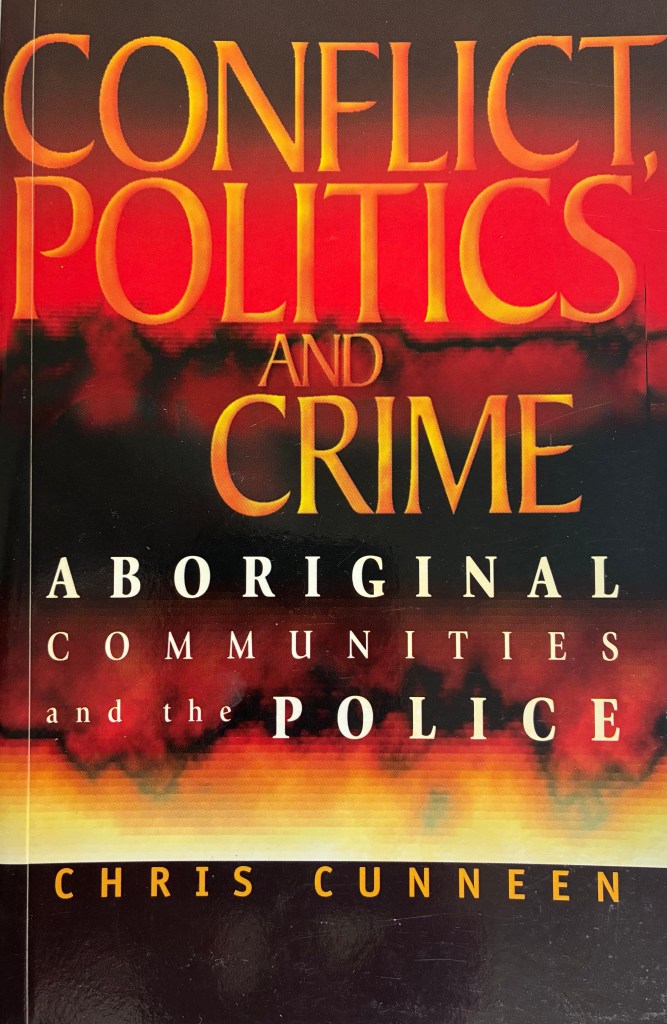
Aboriginal people are grossly over-represented before the courts and in our gaols. Despite numerous inquiries, State and Federal, and the considerable funds spent trying to understand this phenomenon, nothing has changed. Indigenous people continue to be apprehended, sentenced, incarcerated and die in gaols. One part of this depressing and seemingly inexorable process is the behaviour of police.
Drawing on research from across Australia, Chris Cunneen focuses on how police and Aboriginal people interact in urban and rural environments. He explores police history and police culture, the nature of Aboriginal offending and the prevalence of over-policing, the use of police discretion, the particular circumstances of Aboriginal youth and Aboriginal women, the experience of community policing. In exploring these issues, Conflict, Politics and Crime argues that changing the nature of contemporary relations between Aboriginal people and the police is a key to altering Aboriginal over-representation in the criminal justice system, and a step towards the advancement of human rights.
Note: This book was originally published in 2001 by Allen and Unwin. In 2020, Routledge released a paperback, hardcover and e-book version of the original. Further details are available here.
______________________________________________________________________________________
The Aboriginal and Torres Strait Islander Legal Relations, Oxford University Press, 2019. Larissa Behrendt, Chris Cunneen, Terri Libesman and Nicole Watson.
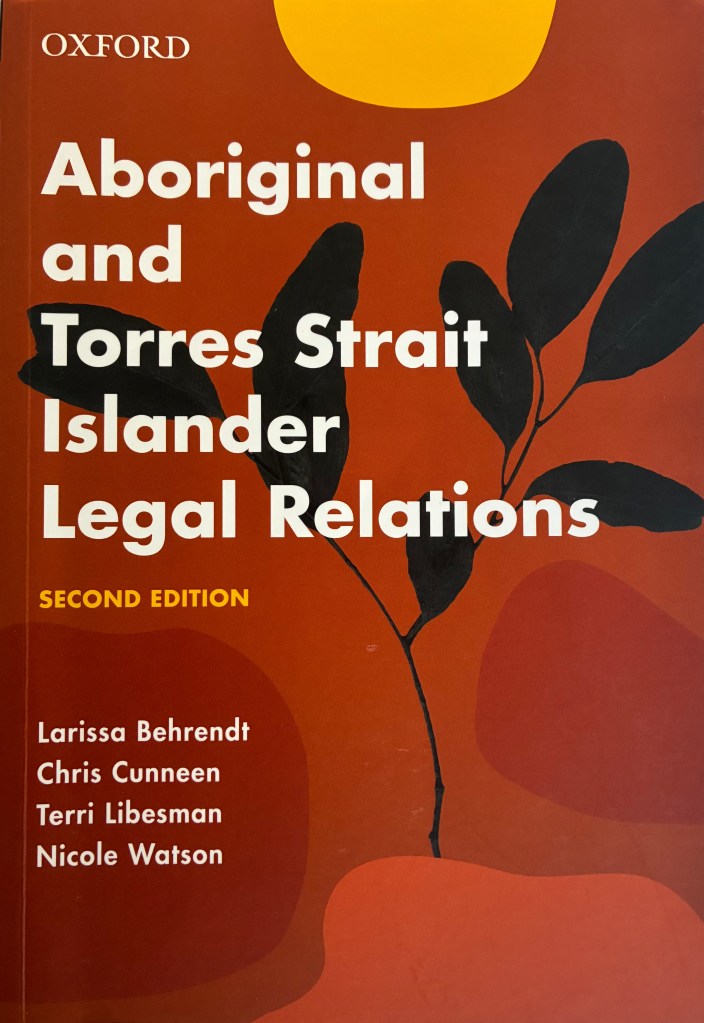
Aboriginal and Torres Strait Islander Legal Relations, second edition, introduces readers to the major issues faced by Aboriginal and Torres Strait Islander people under the Anglo-Australian legal system, with a focus on the impact of historical and contemporary law and policy. It engages readers in key debates, such as reparations for the Stolen Generation and changes to the Constitution, and explores how the law can play a role in providing a framework for recognising Aboriginal and Torres Strait Islander peoples’ rights.
For further information and to purchase the book, contact Oxford University Press
______________________________________________________________________________________
Indigenous Criminology, Policy Press, 2017. Chris Cunneen and Juan Tauri .
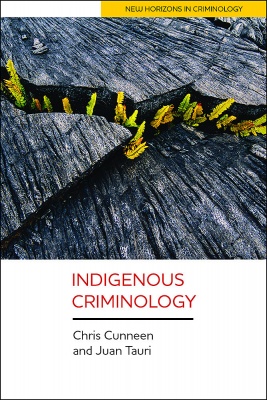
Indigenous Criminology is the first book to comprehensively explore Indigenous people’s contact with criminal justice systems in a contemporary and historical context. Drawing on comparative Indigenous material from North America, Australia and Aotearoa New Zealand, it addresses both the theoretical underpinnings to the development of a specific Indigenous criminology, and canvasses the broader policy and practice implications for criminal justice.
Written by leading criminologists specialising in Indigenous justice issues, the book argues for the importance of Indigenous knowledges and methodologies to criminology, and suggests that colonialism needs to be a fundamental concept to criminology in order to understand contemporary problems such as deaths in custody, high imprisonment rates, police brutality and the high levels of violence in some Indigenous communities. Prioritising the voices of Indigenous peoples, the work will make a significant contribution to the development of a decolonising criminology and will be of wide interest.
“A welcome contribution to the decolonization paradigm in Criminology, a discipline that is complicit in the enslavement, colonization, genocidization and criminalization of Others with repressive fetishes of western modernity.” Biko Agozino, editor, African Journal of Criminology
“A major original contribution providing a valuable theoretical comparative perspective to the limits of traditional Western criminology by defying the status quo and giving Indigenous people a criminological voice.” Stuart Henry, San Diego State University
Thoroughly researched, brilliantly argued, this powerful critique of mainstream criminology carves an elegant and welcome path to critical and responsive Indigenous-informed criminology.” L. Jane McMillan, St. Francis Xavier University, Canada
Book Review of Indigenous Criminology by Leanne Weber in Theoretical Criminology, 21(4), pp. 558-561.
Book Review of Indigenous Criminology by Amanda Porter in Current Issues in Criminology, 31(1), pp. 122-142. 2019.
Book Review of Indigenous Criminology by J. M. Moore in the Howard Journal of Crime and Justice, 56(3), pp. 386-387. September 2017.
For further information and to purchase the book, contact Policy Press.
______________________________________________________________________________________
Justice Reinvestment: Winding Back Imprisonment, Palgrave, 2016. David Brown, Chris Cunneen, Melanie Schwartz, Julie Stubbs and Courtney Young.

Justice reinvestment was introduced as a response to mass incarceration and racial disparity in the United States in 2003. This book examines justice reinvestment from its origins, its potential as a mechanism for winding back imprisonment rates, and its portability to Australia, the United Kingdom and beyond. The authors analyze the principles and processes of justice reinvestment, including the early neighborhood focus on ‘million dollar blocks’. They further scrutinize the claims of evidence-based and data-driven policy, which have been used in the practical implementation strategies featured in bipartisan legislative criminal justice system reforms.
This book takes a comparative approach to justice reinvestment by examining the differences in political, legal and cultural contexts between the United States and Australia in particular. It argues for a community-driven approach, originating in vulnerable Indigenous communities with high imprisonment rates, as part of a more general movement for Indigenous democracy. While supporting a social justice approach, the book confronts significantly the problematic features of the politics of locality and community, the process of criminal justice policy transfer, and rationalist conceptions of policy. It will be essential reading for scholars, students and practitioners of criminal justice and criminal law.
For further information and to purchase the book, see here.
______________________________________________________________________________________
Juvenile Justice, Oxford University Press, 2015. Chris Cunneen, Rob White and Kelly Richards.

Juvenile Justice 5th edition explores youth and crime in Australia, and the institutions and agencies associated with the administration of juvenile justice. It provides an accessible introduction to the main concepts and issues of juvenile justice and critically analyses the principles, policies and practices associated with it. The book provides clear information across a broad range of areas, and raises a number of questions about the institutions of juvenile justice and how we think about issues of juvenile justice.
Juvenile Justice 5th edition explores youth and crime in Australia, and the institutions and agencies associated with the administration of juvenile justice. It provides an accessible introduction to the main concepts and issues of juvenile justice and critically analyses the principles, policies and practices associated with it. The book provides clear information across a broad range of areas, and raises a number of questions about the institutions of juvenile justice and how we think about issues of juvenile justice.
For further information and to purchase the book, contact Oxford University Press
______________________________________________________________________________________
Penal Culture and Hyperincarceration: The Revival of the Prison, Ashgate/Routledge, 2013/2016. Chris Cunneen, Eileen Baldry, David Brown, Mark Brown, Melanie Schwartz and Alex Steel.

What are the various forces influencing the role of the prison in late modern societies? What changes have there been in penality and use of the prison over the past 40 years that have led to the re-valorization of the prison? Using penal culture as a conceptual and theoretical vehicle, and Australia as a case study, this book analyses international developments in penality and imprisonment. Authored by some of Australia’s leading penal theorists, the book examines the historical and contemporary influences on the use of the prison, with analyses of
colonialism, post colonialism, race, and what they term the ’penal/colonial complex,’ in the construction of imprisonment rates and on the development of the phenomenon of hyperincarceration. The authors develop penal culture as an explanatory framework for continuity, change and difference in prisons and the nature of contested penal expansionism. The influence of transformative concepts such as ’risk management’, ’the therapeutic prison’, and ’preventative detention’ are explored as aspects of penal culture. Processes of normalization, transmission and reproduction of penal culture are seen throughout the social realm. Comparative, contemporary and historical in its approach, the book provides a new analysis of penality in the 21st century.
For further information and to purchase the book, contact Routledge
______________________________________________________________________________________
Juvenile Justice,: Youth and Crime in Australia, Oxford University Press, 2011. Chris Cunneen and Rob White .

This revised fourth edition of the book is about youth and crime in Australia, and the institutions and agencies associated with the administration of juvenile justice. It provides an overview and introduction to the main concepts and issues of juvenile justice in a way that is simple and descriptive, yet critical. It provides basic information across a broad range of areas, and in so doing, raises a number of questions about the institutions of juvenile justice and how we think about juvenile justice issues.
______________________________________________________________________________________
Debating Restorative Justice, Bloomsbury, 2010. Chris Cunneen and Caroline Hoyle.

In this first volume of the ‘Debating Law’ series Carolyn Hoyle argues that communities and the state should be more restorative in responding to harms caused by crimes, antisocial behaviour and other incivilities. She supports the exclusive use of restorative justice for many non-serious offences, and favours approaches that, by integrating restorative and retributive philosophies, take restorative practices into the ‘deep end’ of criminal justice. While acknowledging that restorative justice appears to have much to offer in terms of
criminal justice reform, Chris Cunneen offers a different account, contending that the theoretical cogency of restorative ideas is limited by their lack of a coherent analysis of social and political power. He goes on to argue that after several decades of experimentation, restorative justice has not produced significant change in the criminal justice system and that the attempt to establish it as a feasible alternative to dominant practices of criminal justice has failed. This lively and valuable debate will be of great interest to everyone interested in the criminal justice system.
Book Review of Debating Restorative Justice by
 Profile