
Defund the Police. An International Insurrection, Policy Press, 2023.
How accurate is the view in western liberal democracies of the police as guardians of public safety and enforcers of the law? Given police violence and the failure of many attempts at reform on a broader global scale, attention has turned to other models, including defunding the police and instead funding alternatives to criminalisation and incarceration. The book also argues that models of policing in many countries are deeply rooted in the colonial experience and continue systemic practices of oppression.
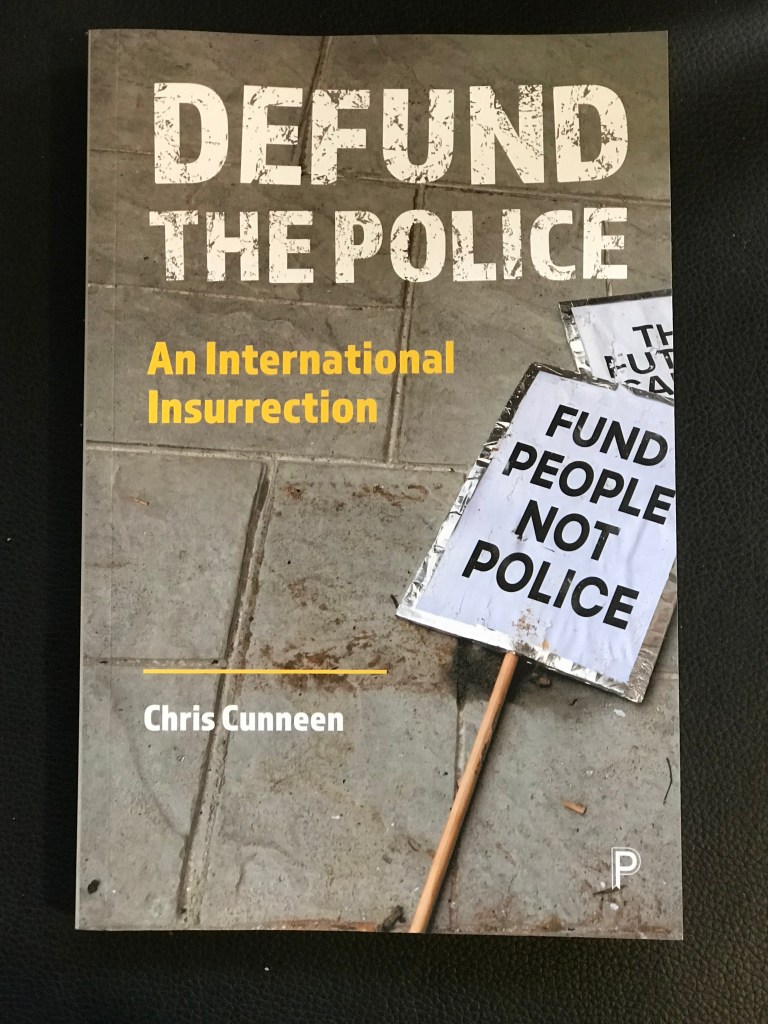
A clear analysis of the worldwide ‘insurrection’ against deadly use of force by the militarised police. Cunneen shows that death in custody and resistance are problems for all and not just groups like BLM’. Onwubiko Agozino, Virginia Tech.
A much needed overview of the failures of police to provide either safety of justice, which lays out the principles and concrete strategies that can lead us toward a police-free future’. Alex S. Vitale, Brooklyn College CUNY.
‘A persuasive and powerful articulation of the critiques of policing and an evidence base for alternative approaches from one of the world’s most eminent and erudite criminologists… an absolute must-read’. Larissa Behrendt, University of Technology Sydney.
Book Review of Defund the Police by Leanne Weber in Theoretical Criminology , 21(1), pp. 128-131, 2025.
Book Review of Defund the Police by John Buttle in Decolonization of Criminology and Justice, 6(2), pp. 75-78, 2024.
For Podcasts and other media relating to Defund the Police, see Media.
You can find further information and order the book from Policy Press
______________________________________________________________________________________
The Routledge International Handbook on Decolonizing Justice, Routledge, 2023. Edited by Chris Cunneen, Angie Deckert, Amanda Porter, Juan Tauri & Rob Webb.
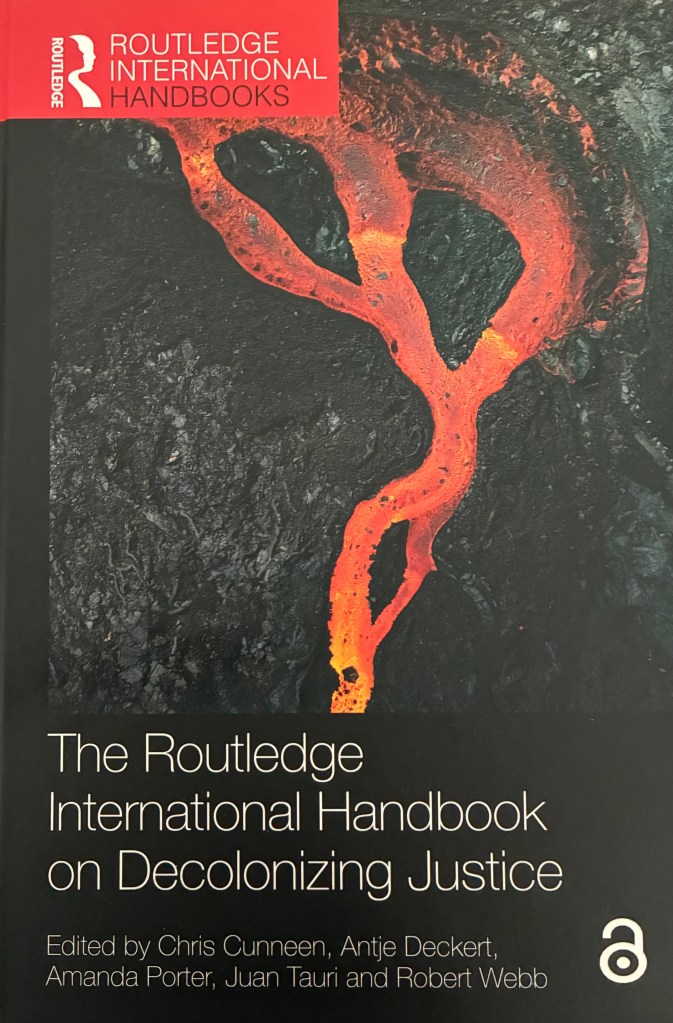
The Routledge International Handbook on Decolonizing Justice focuses on the growing worldwide movement aimed at decolonizing state policies and practices, and various disciplinary knowledges including criminology, social work and law. The collection of original chapters brings together cutting-edge, politically engaged work from a diverse group of writers who take as a starting point an analysis founded in a decolonizing, decolonial and/or Indigenous standpoint.
Centring the perspectives of Black, First Nations and other racialized and minoritized peoples, The Routledge International Handbook on Decolonizing Justice makes an internationally significant contribution to the literature. The book focuses on the growing worldwide movement aimed at decolonizing state policies and practices, and various disciplinary knowledges including criminology, social work and law. The collection of original chapters brings together cutting-edge, politically engaged work from a diverse group of writers who take as a starting point an analysis founded in a decolonizing, decolonial and/or Indigenous standpoint.
The chapters include analyses of specific decolonization policies and interventions instigated by communities to enhance jurisdictional self-determination; theoretical approaches to decolonization; the importance of research and research ethics as a key foundation of the decolonization process; crucial contemporary issues including deaths in custody, state crime, reparations, and transitional justice; and critical analysis of key institutions of control, including police, courts, corrections, child protection systems and other forms of carcerality.
The handbook is divided into five sections which reflect the breadth of the decolonizing literature: Why decolonization? From the personal to the global; State terror and violence; Abolishing the carceral; Transforming and decolonizing justice; and Disrupting epistemic violence.
This book offers a comprehensive and timely resource for activists, students, academics, and those with an interest in Indigenous studies, decolonial and post-colonial studies, criminal legal institutions and criminology. It provides critical commentary and analyses of the major issues for enhancing social justice internationally.
The Handbook on Decolonizing Justice has 47 chapters. There are short 2-3 minute videos prepared by 18 of our authors discussing their individual contributions. These videos can be found on YouTube.
Book Review of The Routledge International Handbook on Decolonizing Justice by Leon Laidlaw in Crime, Media, Culture, 20(4), pp. 447-450, October 2024.
This book is OPEN ACCESS
______________________________________________________________________________________
Rethinking Community Sanctions. Social Justice and 21st Century Penal Control, Emerald Publishing, 2023. Julie Stubbs, Sophie Russell, Eileen Baldry, David Brown, Chris Cunneen and Melanie Schwartz.

Rethinking Community Sanctions: Social Justice and Penal Control redresses the invisibility of community sanctions in a popular imaginary dominated by the prison, resulting in their being seen as ‘not prison’, ‘not punishment’, a ‘let off’, or expression of mercy.
Based on insights from interviews with key participants in 3 Australian jurisdictions, case studies of selected programs and policies, and the international literature, the authors focus on the effects of community sanctions among groups vulnerable to penal control: First Nations peoples, women, and those with disabilities, along with those at the intersections of these groups.
Arguing that developing a better, more democratic politics around community sanctions requires coming to terms with the wider carceral web in which vulnerable groups are ensnared, they demonstrate the importance of connecting criminal legal system struggles with broader movements for community control, self-determination, and sovereignty.
What do community sanctions look like in Australia in the 21st century? What can be done to realize their progressive potential and minimize their insidious effects? This lively, theoretically informed, empirically grounded book, written by a group of scholars with a deep knowledge of Australia’s penal system, opens up new ways of thinking about a form of sanctioning that is widely used but little understood. David Garland, New York University.
Drawing on the leading international literature on punishment, and further contributing to it, Rethinking Community Sanctions provides the first book-length study of community sanctions in Australia that is both comprehensive in scope and critical in nature. It redresses the profound imbalance between the critical attention devoted to the prison as a sanction and that directed at the far more common reliance on punishment and surveillance in the community, and it carefully elucidates the connections between the two. It does so with particular reference to those most vulnerable to being ensnared in the carceral dragnet. And it offers a positive alternative vision for the future of community sanctions. As much as academics should be drawn to this book, so too should lawyers, criminal justice practitioners and politicians who care about the current trajectory of the penal system. Russell Hogg, Honorary Professor UNSW.
This brilliant book offers the first critical analysis of community sanctions in contemporary Australia – but its contribution goes much further than that. It is the first study anywhere to properly develop a decolonizing perspective on this topic. Both by putting the present-day injustices in their proper historical context and by centering three populations who are too often marginalized in and by penal policy, practice and scholarship (indigenous people, women and people with mental health disorders and/or cognitive disabilities), this book represents a major advance in the study of probation and parole, but also in how we understand relationships between punishment, community and society more generally. Everyone who cares about those relationships should read it, digest it and use it. Fergus McNeill, Professor of Criminology and Social Work, University of Glasgow
A compelling, comprehensive conceptual and empirical analysis of the social, political, and legal nuances of community correctional practices in Australia, this book shows how the risk episteme underpinning community sanctions is limited and has differential effects on women, people with disabilities, and racialized and Indigenous populations. The authors challenge us to reflect on the administrative and operational limits of these sanctions, binaries of community/custody, welfarist/risk, and harsh/ ‘soft’ penalties. Readers are asked to scrutinize how technological, sociopolitical, and populist rationalities reconfigure supervision, while simultaneously remaining hopeful about the potential of ‘community’ sanctions. Kelly Hannah-Moffat, Professor in Criminology and Sociolegal Studies, University of Toronto.
You can find further information and order the book from Emerald
______________________________________________________________________________________
Youth Penality in Comparative Context, Routledge, 2020. Barry Goldson, Chris Cunneen, Sophie Russell, Eileen Baldry, David Brown, Melanie Schwartz and Damon Briggs.

This book represents the first major analysis of Anglo-Australian youth justice and penality to be published and it makes significant theoretical and empirical contributions to the wider field of comparative criminology. By exploring trends in law, policy and practice over a forty-year period, the book critically surveys the ‘moving images’ of youth justice regimes and penal cultures, the principal drivers of reform, the core outcomes of such processes and the overall implications for theory building.
Unsettling maybe, but inspiring for sure. Professor Jenneke Christiaens, Vrije Universiteit Brussel, Belgium.
This book is a triumph. Professor Lesley McAra, University of Edinburgh, Scotland.
Sophisticated, erudite and well argued it makes original contributions . Professor David Nelken, Kings College London, England.
An essential contribution to comparative penology and the study of policy mobilities. Professor Coretta Phillips, London School of Economics, England.
Excellent, innovative and a compelling read. Professor John Pratt, Victoria University of Wellington, New Zealand.
Rich both in methods and in substance… invaluable reading for researchers in the field of comparative criminology. Professor Tapio Lappi-Seppälä, University of Helsinki, Finland.
The book brings hope too – in affirming human rights standards as… symbolic beacons lighting pathways to justice for children and young people . Professor Ann Skelton, University of Pretoria, South Africa.
A terrific book… intellectually demanding, theoretically informed, critical in orientation and challenging of established wisdom. Distinguished Professor Rob White, University of Tasmania, Australia.
Book Review of Youth Penality in Comparative Context by Jasmina Arnez in Punishment and Society, 25(3), pp. 816-817, July 2023.
You can find further information and order the book from Routledge
______________________________________________________________________________________
Crime, Deviance and Society: An Introduction to Sociological Criminology, Cambridge University Press, 2020. Ana Rodas, Melanie Simpson, Paddy Rawlinson, Ronald Kramer, Emma Ryan, Emmeline Taylor, Reece Walters, Alan Beckley, Chris Cunneen, Ashlee Gore, Amanda Porter, Scott Poynting, Emma Russell
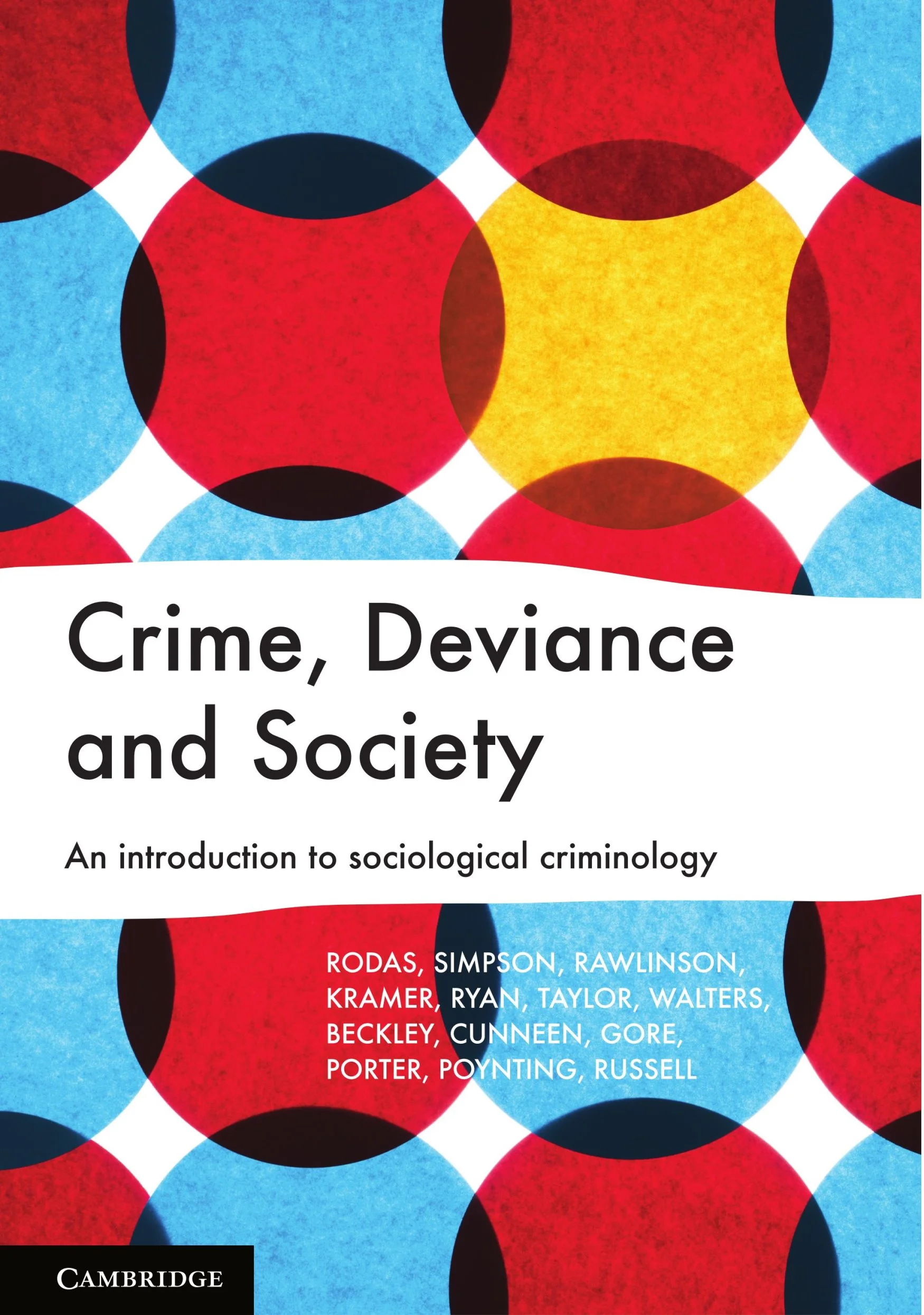
This book offers a comprehensive introduction to criminological theory. The book introduces readers to key sociological theories, such as anomie and strain, and examines how traditional approaches have influenced the ways in which crime and deviance are constructed. It provides a nuanced account of contemporary theories and debates, and includes chapters covering feminist criminology, critical masculinities, cultural criminology, green criminology, and postcolonial theory, among others.
You can find further information and order the book from Cambridge University Press
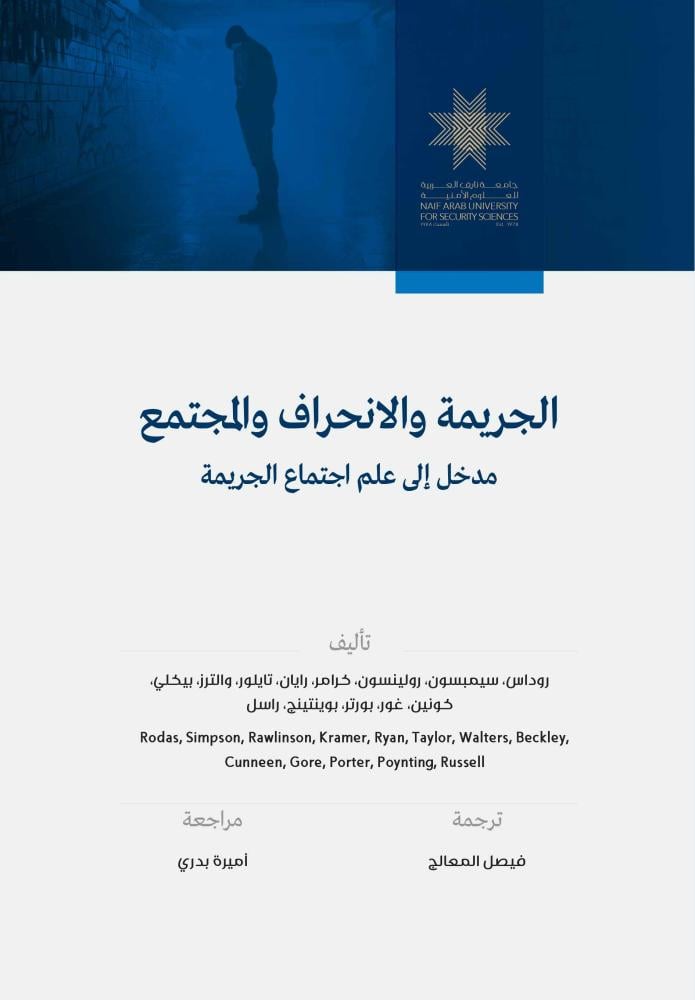
Crime, Deviance and Society has also been translated into Arabic.
The publisher is Naif University Press (2024). Further information is available here.
 Profile